Rethinking Authorization for Autonomous Systems
Traditional identity and access management (IAM) systems were built for predictable users and deterministic workflows. However, the rise of agentic AI introduces autonomous, non-deterministic actors that demand a fundamentally different authorization approach. These AI agents require a model that blends identity, delegation, runtime policy evaluation, and ephemeral authorization—far beyond simple access controls. Organizations increasingly need access mechanisms that closely tie agent identity to temporary, tightly scoped permissions tied to specific transaction contexts.
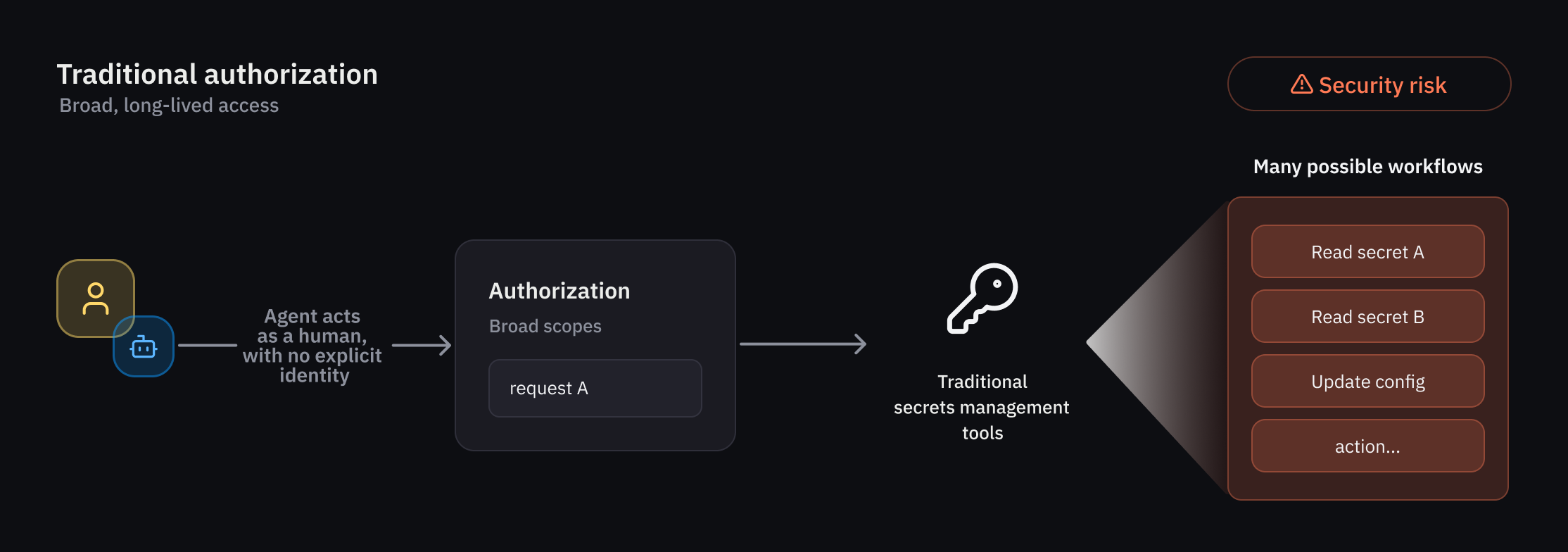
Key Challenges with AI Agent Security
As enterprises adopt AI agents across diverse environments, HashiCorp Vault customers are seeking new identity and security controls designed specifically for autonomous systems. The primary challenges include:
- Enforcing guardrails for agents that operate less predictably than humans or traditional non-human identities (NHIs).
- Fine-grained authorization evaluated at runtime, scoped to individual actions or workflows.
- Clear attribution and auditability for actions performed on behalf of users.
- A standardized approach for securing AI agents across environments and workflows.
Vault’s New Capabilities for Agentic Workflows
To address these unique operational and security characteristics, HashiCorp has built new Vault capabilities designed specifically for agentic workflows. These include an agent registry, granular identity-based policies for agents, and per-request (ephemeral) authorization controls. The latter reduces risk by granting temporary access rights that expire after a specific task or timeframe.
Agentic Identities: The Agent Registry
The agent registry allows developers to register and manage agent activity separately from human and traditional non-human identities. This agent-specific oversight is critical in delegation flows, where an agent uses an on-behalf-of (OBO) pattern from a human user with delegation and consent. By explicitly tracking this delegation, the agent registry forms the starting point for a dedicated framework of registration, authorization, credential management, and observability.
Enforcing Granular Identity-Based Policies
Least privilege access is a top priority for organizations, especially regarding agents. Vault addresses this through a rich set of policy-based runtime controls that allow administrators to strictly govern agent activity. Because agent behavior can be non-deterministic, Vault applies deterministic guardrails and per-request access control. Additionally, since agents often operate in delegation mode—carrying the authority of a human user—Vault evaluates trust across multiple dimensions as agents use the system to access secrets and credentials for target systems.
Per-Request Authorization and Delegation
Vault’s per-request authorization model ensures that each action an agent performs is individually authenticated and authorized. This ephemeral approach minimizes the risk of credential misuse by ensuring that permissions are granted only for the immediate context and then revoked. Combined with clear delegation tracking, organizations gain full visibility into who (or what) initiated a request and how it was fulfilled.
Availability and Next Steps
Select customers are currently evaluating these capabilities through an early access program. Broader public beta availability is planned for a future Vault release later this summer. For more details, see the agent registry and granular policies sections above.